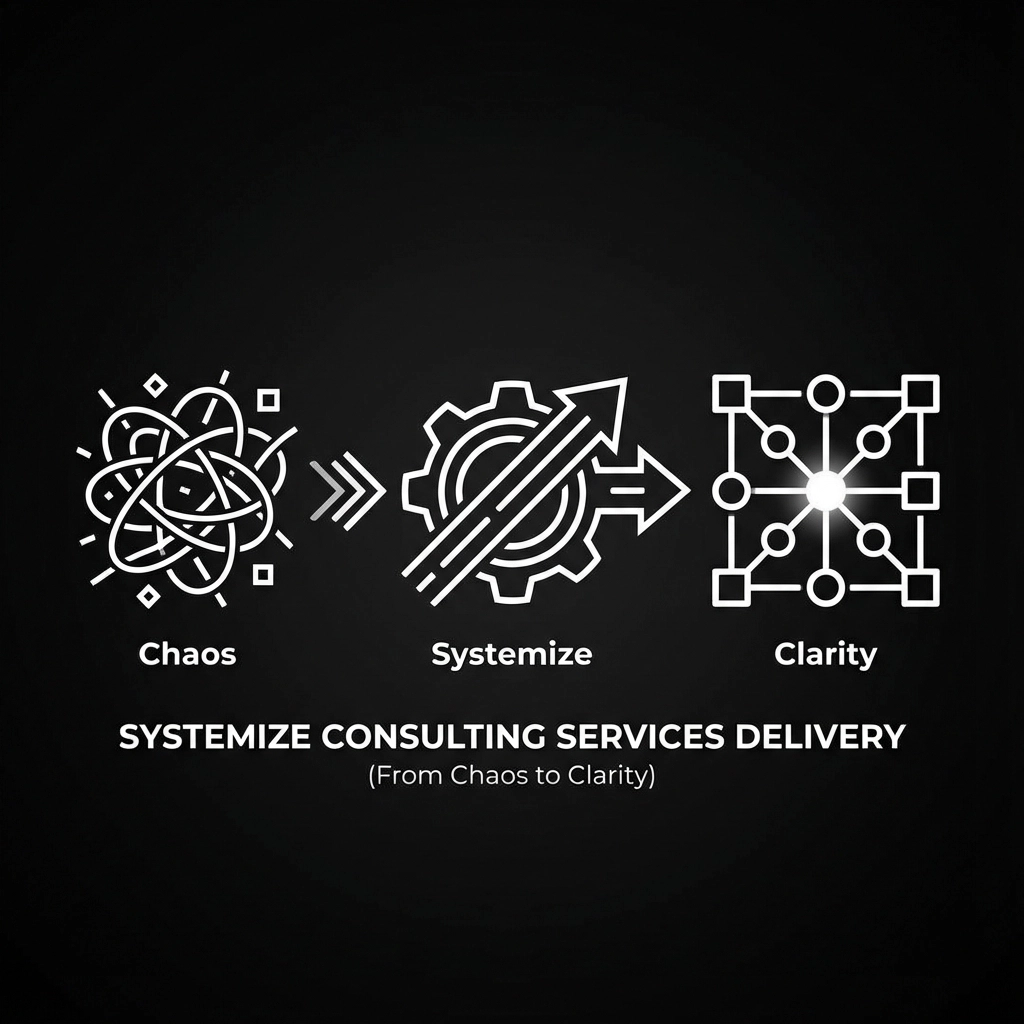
Are you running your consulting business like a "Swiss cheese operation" where critical steps randomly fall through holes?
If you're delivering $50K+ engagements but still scrambling to remember what you did for the last client, you're trapped in the CHAOS CYCLE. Every project feels like you're starting from scratch. Your team (if you have one) keeps asking the same questions. Clients get inconsistent experiences. And you're working 60+ hour weeks just to maintain quality.
The brutal truth? Most six-figure consultants are running glorified freelance operations disguised as systematic businesses.
Here's how to break free and build a consulting delivery machine that works WITHOUT your constant oversight.
Map Your Complete Client Journey (Stop Flying Blind)
Before you can systemize anything, you need COMPLETE VISIBILITY into what actually happens during your engagements.
Most consultants think they know their process. They're wrong.
Grab a whiteboard and map out EVERY touchpoint from initial contact through final deliverable. We're talking about 15+ distinct steps most consultants never document:
- Initial inquiry response (within 2 hours)
- Discovery call scheduling and preparation
- Proposal creation and customization
- Contract execution and payment processing
- Project kickoff and stakeholder alignment
- Weekly check-ins and progress reports
- Deliverable creation and client review cycles
- Implementation support and handoff
- Project closure and success metrics review
- Follow-up and upsell opportunity identification
Without this foundation map, you're building systems on quicksand.
Each phase needs specific inputs, processes, outputs, and success criteria. Document the resources required, typical timeframes, and potential bottlenecks. This isn't busy work: it's the blueprint for your entire scaling strategy.

Establish Core Service Delivery Phases (Your Business Operating System)
Transform your ad-hoc approach into a STANDARDIZED FRAMEWORK that works regardless of client size or complexity.
Phase 1: Strategic Onboarding (Week 1)
Set the foundation for success with structured client orientation, expectation alignment, and project scoping. Include welcome sequences, stakeholder mapping, and communication protocol establishment.
Phase 2: Discovery & Planning (Weeks 2-3)
Conduct systematic information gathering using standardized questionnaires, interviews, and data collection processes. Develop detailed project blueprints with clear milestones and dependencies.
Phase 3: Implementation & Execution (Weeks 4-8)
Execute planned work using documented methodologies and quality checkpoints. Maintain consistent communication through scheduled touchpoints and progress reporting.
Phase 4: Delivery & Optimization (Weeks 9-10)
Present findings and recommendations through standardized formats. Facilitate implementation support and knowledge transfer to client teams.
Phase 5: Closure & Expansion (Week 11+)
Conduct project retrospectives, gather testimonials, and identify follow-on opportunities through systematic relationship nurturing.
This framework gives you PREDICTABLE TIMELINES and helps clients understand exactly what to expect throughout the engagement.
Create Standard Operating Procedures (Your Knowledge Insurance Policy)
SOPs aren't just documentation: they're your "business brain backup" that prevents critical knowledge from walking out the door.
Start with your THREE most frequently repeated activities:
Client Onboarding SOP:
- Send welcome email within 4 hours of contract signature
- Schedule kickoff call using standardized agenda template
- Create project workspace in management system
- Distribute stakeholder contact sheet and communication guidelines
- Conduct 90-minute alignment session using structured framework
Weekly Progress Review SOP:
- Pull metrics from tracking dashboard every Monday 9 AM
- Prepare standardized status report using template
- Identify blockers and resource needs
- Send update to client by Tuesday 5 PM
- Log insights in project knowledge base
Deliverable Creation SOP:
- Use standardized templates for all client-facing materials
- Follow 3-stage review process (draft → internal review → client presentation)
- Include implementation roadmap and success metrics
- Deliver via secure client portal with tracking capabilities
Each SOP should answer: WHO does WHAT, WHEN, WHERE, and HOW. Include screenshots, templates, and decision trees for complex scenarios.
Bottom line: If it's not documented, it doesn't exist in a scalable business.

Define Clear Delivery Workflows (Eliminate Decision Fatigue)
Workflows connect your SOPs into seamless operational sequences that run automatically.
Map out EXACTLY what happens after each major milestone:
Post-Contract Workflow:
Contract signed → Slack notification → Project manager assigned → Client portal created → Welcome sequence triggered → Kickoff scheduled → Stakeholder contacts gathered → Project workspace configured
Weekly Review Workflow:
Monday metrics pull → Status report generation → Internal review → Client communication → Follow-up task creation → Next week planning
Deliverable Approval Workflow:
Draft completion → Internal QA → Client presentation → Feedback incorporation → Final approval → Implementation handoff
Use conditional logic for different engagement types. A $25K strategy project follows different workflows than a $100K implementation engagement.
The goal: Your team should NEVER have to ask "What happens next?"
Implement Supporting Tools and Systems (Your Technology Stack)
Stop trying to manage complex engagements with email and spreadsheets. You need INTEGRATED SYSTEMS that create seamless client experiences.
Essential Stack Components:
Project Management Hub: Monday.com or Asana with automated workflows, client portal access, and progress tracking. Configure templates for each engagement type with pre-built task sequences and dependencies.
Communication Platform: Dedicated Slack workspaces for each client with organized channels for different project streams. Automate status updates and milestone notifications.
Knowledge Management: Notion or Confluence for centralized documentation, templates, and process guides. Include search functionality and version control for all client-facing materials.
Client Portal: Branded interface where clients access project updates, deliverables, and communication. Integrate with your project management system for real-time visibility.
Analytics Dashboard: Track key performance metrics like project velocity, client satisfaction scores, and resource utilization. Use this data to optimize your delivery processes continuously.
These systems should TALK TO EACH OTHER through automated integrations. When a project milestone is completed, it should automatically trigger client notifications, update dashboards, and create follow-up tasks.
Build Templates and IP Assets (Your Competitive Moat)
Templates aren't just time-savers: they're your INTELLECTUAL PROPERTY ASSETS that create consistent quality and accelerate delivery.
Essential Template Library:
Strategy Framework Templates: Pre-built assessment tools, analysis frameworks, and recommendation formats specific to your methodology. Include calculation engines and scenario modeling tools.
Communication Templates: Email sequences for each project phase, meeting agendas, status report formats, and presentation decks with your branding and messaging.
Diagnostic Tools: Questionnaires, assessment rubrics, and evaluation frameworks that position you as the expert while gathering critical project information.
Implementation Guides: Step-by-step roadmaps, training materials, and handoff documentation that ensure successful client adoption of your recommendations.
Each template should include USAGE INSTRUCTIONS and customization guidelines. Your goal: 80% of every deliverable comes from proven templates, with 20% customization for client-specific needs.
Pro tip: Charge premium rates for proprietary methodologies and frameworks that deliver predictable results.

Monitor Performance and Iterate (Continuous Improvement Engine)
Most consultants deliver projects and never look back. That's leaving money and efficiency gains on the table.
Implement SYSTEMATIC PERFORMANCE TRACKING across three dimensions:
Client Success Metrics:
- Project completion rate (target: 95%+)
- On-time delivery percentage (target: 90%+)
- Client satisfaction scores (target: 4.5/5+)
- Recommendation implementation rate (target: 80%+)
Operational Efficiency Metrics:
- Average project duration vs. planned timeline
- Resource utilization rates by team member
- Template usage percentage across projects
- Process deviation incidents and root causes
Business Growth Metrics:
- Client retention and upsell rates
- Referral generation from completed projects
- Profit margins by project type and size
- Capacity utilization and scaling readiness
Schedule monthly retrospectives to review these metrics and identify improvement opportunities. Use client feedback surveys, team input, and performance data to refine your SOPs and workflows continuously.
The result: A delivery machine that gets BETTER with every engagement, not just busier.
Scale Through Standardization (Your Growth Multiplication Strategy)
Once your core processes are documented and optimized, you can RAPIDLY EXPAND without sacrificing quality or requiring heroic efforts.
Scaling Leverage Points:
Service Line Extension: Use your proven delivery framework to launch adjacent services. Your project management processes, client communication systems, and quality standards apply across multiple offerings.
Team Expansion: New team members can deliver consistent results immediately using your documented SOPs and templates. Reduce onboarding time from months to weeks.
Geographic Growth: Replicate your systematic approach in new markets without rebuilding processes from scratch. Your systems become location-independent business assets.
Partnership Opportunities: License your methodologies and delivery systems to other consultants or agencies. Your standardized approach becomes a scalable revenue stream.
The compound effect is powerful: Each systematized process becomes a BUILDING BLOCK for multiple growth initiatives. Instead of linear scaling (more time = more revenue), you achieve exponential scaling (better systems = disproportionate results).
System Status: Ready for deployment across your entire consulting operation.
Your consulting business doesn't have to run on chaos and heroic individual efforts. With systematic delivery processes, you create predictable client experiences, reduce your personal dependency, and build a scalable operation that works whether you're in the office or on vacation.
The consultants who master systematic delivery don't just grow bigger: they build businesses that create wealth and freedom simultaneously.
Leave a Reply